FEMIS ID: Name: Class:
STRAND 1: Social Organisation & Processes · 26 marks
Question types: Multiple Choice (10) • Matching (6) • Comprehension Passage (5) • Paragraph Writing (5)
Part A — Multiple Choice [10 marks]
1. The World Environment Organisation (WEO) protects
✔ Answer: D
2. Samoa, Tonga and Easter Island are home to the
✔ Answer: D
3. People with straight black hair and inner eye folds — such as the Japanese and Chinese — are called
✔ Answer: D
4. The i-Taukei are the indigenous people of
✔ Answer: D
5. Fijians established their identity as a Pacific community mainly through
✔ Answer: B
6. UNICEF was created by the UN General Assembly on 11 December
✔ Answer: A
7. The FAO of the United Nations works hard to defeat
✔ Answer: D
8. The World Bank mainly
✔ Answer: B
9. A country which is NOT a member of the United Nations is
✔ Answer: D
10. Fiji belongs to which group of Pacific islands?
✔ Answer: B
Part B — Matching [6 marks]
1. Groups sharing customs
✔ Answer: A
2. Groups sharing income level
✔ Answer: B
3. Groups sharing faith
✔ Answer: C
4. Groups sharing ancestry
✔ Answer: D
5. Groups sharing language
✔ Answer: E
6. Groups sharing work
✔ Answer: F
Part C — Comprehension Passage [5 marks] "UNICEF Works for Children"
December 1946 to bring emergency food and healthcare to children suffering after World War II. Its founder, Ludwik Rajchman, believed no child should be forgotten. Today UNICEF builds classrooms, trains teachers, provides clean water and vaccinates children in more than 190 countries. In Fiji, UNICEF has supported cyclone-proof schools and child health programmes, helping every child to learn and grow safely.
1. When and by whom was UNICEF created?
✔ Model answer: (see the Detailed Solution PDF)
2. Why was UNICEF first set up?
✔ Model answer: (see the Detailed Solution PDF)
3. What did Ludwik Rajchman believe?
✔ Model answer: (see the Detailed Solution PDF)
4. List TWO things UNICEF does today.
✔ Model answer: (see the Detailed Solution PDF)
5. How has UNICEF helped schools in Fiji?
✔ Model answer: (see the Detailed Solution PDF)
Part D — Paragraph Writing [5 marks]
STRAND 2: Time, Continuity & Change · 22 marks
Question types: Multiple Choice (8) • True/False (6) • Fill in the Blanks (4) • Resource Interpretation (4)
Part A — Multiple Choice [8 marks]
1. The first person to walk on the moon was
✔ Answer: C
2. The first President of Fiji was
✔ Answer: D
3. Bill Gates became famous as the founder of
✔ Answer: A
4. Fiji gained independence in the year
✔ Answer: A
5. The African president renowned for combating apartheid was
✔ Answer: A
6. Roy Krishna is famous as a
✔ Answer: D
7. A medical pandemic from the list below is
✔ Answer: A
8. The first South Pacific Games (now Pacific Games) were held in
✔ Answer: D
Part B — True or False [6 marks]
1. Globalisation has influenced Pacific economies through tourism.
✔ Answer: T
2. Aborigines are the indigenous people of Asia.
✔ Answer: F
3. The Second World War involved many nations of the world.
✔ Answer: T
4. People from different ethnic groups living together can be described as cultural diversity.
✔ Answer: T
5. Sea level rise is a consequence of global warming.
✔ Answer: T
6. Frequent use of credit and debit cards decreases our spending.
✔ Answer: F
Part C — Fill in the Blanks [4 marks]
1. World War I began in 19 and Fiji became independent in 19. (2 marks)
✔ Answers: 1914; 1970
2. The Red Cross was founded in 18 and the next Commonwealth Games (2026) will be held in , Scotland. (2 marks)
✔ Answers: 1863; Glasgow
Part D — Resource Interpretation [4 marks] study the photograph

1. Who is the person in the photograph?
✔ Model answer: (see the Detailed Solution PDF)
2. Which sport is he famous for?
✔ Model answer: (see the Detailed Solution PDF)
3. Name ONE club he played for overseas.
✔ Model answer: (see the Detailed Solution PDF)
4. How does he inspire young sportspeople in Fiji?
✔ Model answer: (see the Detailed Solution PDF)
STRAND 3: Place & Environment · 26 marks
Question types: Multiple Choice (10) • Matching (6) • Short-Answer Questions (6) • Resource Interpretation (4)
Part A — Multiple Choice [10 marks]
1. The four climatic zones include the Polar, Temperate, Tropics and
✔ Answer: B
2. Water pollution is caused mainly by
✔ Answer: D
3. The Prime Meridian is zero degrees
✔ Answer: B
4. The shape of an area of land — its hills, valleys and mountains — is called
✔ Answer: B
5. A renewable source of energy is
✔ Answer: D
6. The longest line of latitude is the
✔ Answer: B
7. As we move higher up a mountain, the weather becomes
✔ Answer: A
8. One way to reduce the effects of climate change is to
✔ Answer: C
9. Lines of longitude run
✔ Answer: A
10. The Sahara Desert belongs to which climatic region?
✔ Answer: D
Part B — Matching [6 marks]
1. Energy that cannot be replaced
✔ Answer: A
2. Protected coastal ecosystems
✔ Answer: B
3. Energy from the sun
✔ Answer: C
4. Damage to land by rubbish
✔ Answer: D
5. Reduce, re-use and...
✔ Answer: E
6. Using resources so they last
✔ Answer: F
Part C — Short-Answer Questions [6 marks]
1. Explain why the Tropic of Capricorn is important.
✔ Model answer: (see the Detailed Solution PDF)
2. Name two animals that inhabit the Arctic region.
✔ Model answer: (see the Detailed Solution PDF)
3. State two negative effects of natural disasters for Fiji.
✔ Model answer: (see the Detailed Solution PDF)
Part D — Resource Interpretation [4 marks] study the resource
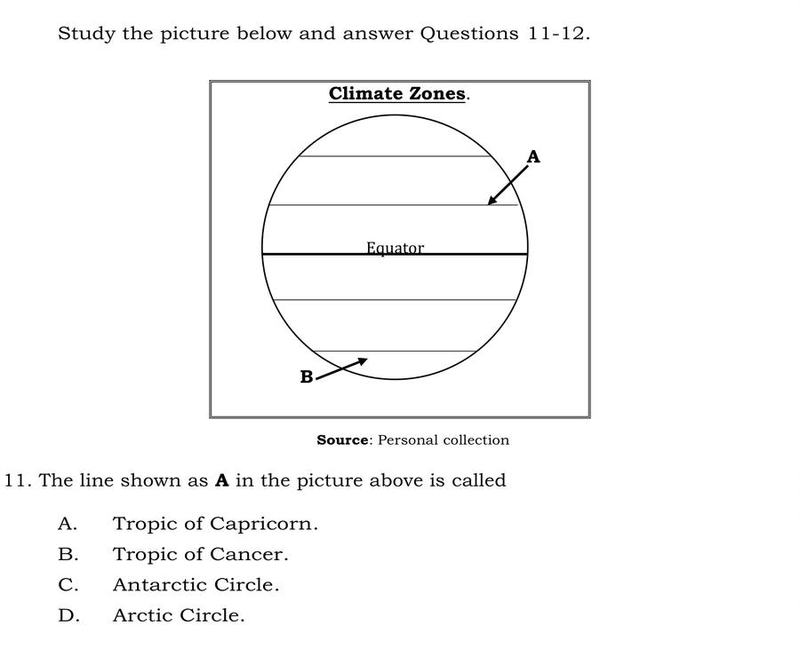
1. Name the line at 0 degrees latitude.
✔ Model answer: (see the Detailed Solution PDF)
2. At which degrees do the Tropics lie?
✔ Model answer: (see the Detailed Solution PDF)
3. Describe the climate near the poles.
✔ Model answer: (see the Detailed Solution PDF)
4. Name the climate zone around the Equator.
✔ Model answer: (see the Detailed Solution PDF)
STRAND 4: Resources & Economic Activities · 26 marks
Question types: Multiple Choice (10) • Matching (6) • Comprehension Passage (5) • Paragraph Writing (5)
Part A — Multiple Choice [10 marks]
1. Globalisation refers to the emergence of an international network of
✔ Answer: D
2. Sustainability means
✔ Answer: D
3. Goods made in China, Japan and the USA sold in a Suva supermarket show we live in a
✔ Answer: B
4. An example of a financial institution is a
✔ Answer: C
5. Globalisation comes from “globe” and means the coming together of countries — a fast
✔ Answer: C
6. A budget is best described as a plan of
✔ Answer: A
7. Which of the following is a non-renewable source of energy?
✔ Answer: A
8. Aid from donor countries is
✔ Answer: D
9. In a family budget, which item is placed under INCOME?
✔ Answer: A
10. A common feature of globalisation is the rise of
✔ Answer: D
Part B — Matching [6 marks]
1. Spending less than you earn
✔ Answer: A
2. Money gained from work
✔ Answer: B
3. Bank account for saving
✔ Answer: C
4. A list of items to buy
✔ Answer: D
5. Plan of your study hours
✔ Answer: E
6. Money paid out
✔ Answer: F
Part C — Comprehension Passage [5 marks] "Time - The Resource You Cannot Store"
time is different: once an hour is gone, it can never be brought back. That is why wise people manage their time carefully. They set priorities, do the most important tasks first, and keep a timetable. Students who plan their study time finish their work with less stress and still have time for family and sport. A fortnight has fourteen days - plan them well!
1. Which resource can never be stored?
✔ Model answer: (see the Detailed Solution PDF)
2. List TWO things that CAN be stored.
✔ Model answer: (see the Detailed Solution PDF)
3. What are TWO good time management habits?
✔ Model answer: (see the Detailed Solution PDF)
4. How do students benefit from planning study time?
✔ Model answer: (see the Detailed Solution PDF)
5. How many days are in a fortnight?
✔ Model answer: (see the Detailed Solution PDF)
Part D — Paragraph Writing [5 marks]